Is an AI-generated background a deepfake? Surprising examples from the European Commission’s guidelines
Is an advert with an AI-generated background a deepfake? I look at the European Commission’s examples and the problems with interpreting the AI Act definition.
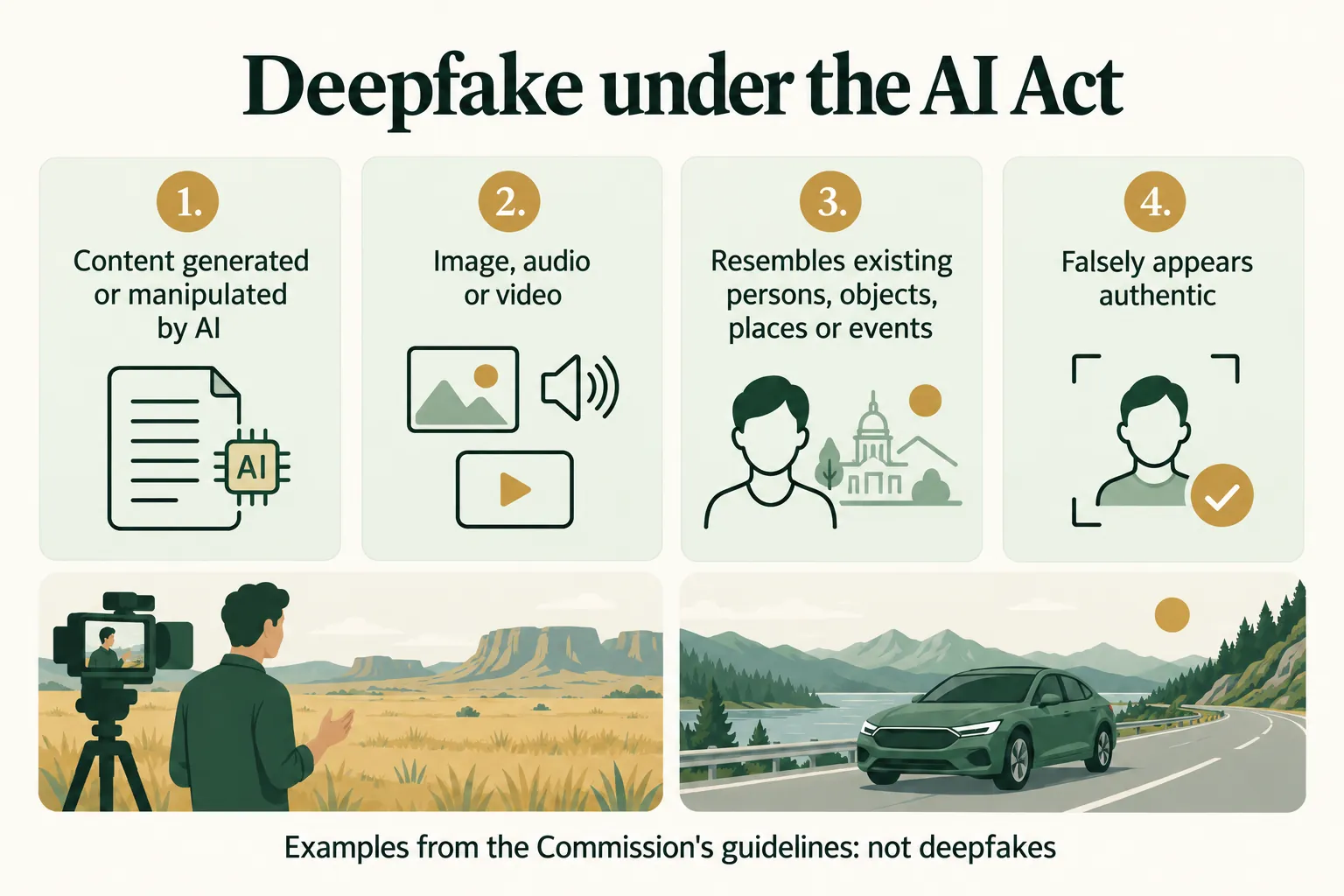
An advert shows a real car, but the landscape behind it was generated by artificial intelligence. Is that material a deepfake? The European Commission’s guidelines on the AI Act contain an answer that, at first glance, seems to me to contradict the very definition of a deepfake.
Two examples that raise doubts
On 20 July 2026 the European Commission published Guidelines on the implementation of the transparency obligations for certain AI systems under Article 50 of the AI Act. On page 36, which is page 37 of the PDF file, I found two interesting examples of content that is not considered a deepfake.
The first concerns a film in which real actors appear against a background generated by AI. The actors themselves are not altered, but their surroundings are. The Commission gives a fictional stretch of prairie and the historical buildings of ancient cities as examples.
The second example concerns advertising. A real product, such as a car, is shown in surroundings created by artificial intelligence. According to the Commission, such material is not a deepfake, provided the advert does not mislead viewers about the product’s real appearance, its features or how it is used.
Both examples are particularly interesting for companies that use generative AI in marketing. They show that the mere presence of realistic AI-generated elements does not necessarily make the whole material a deepfake.
That still does not solve my basic problem with interpreting the rules.
Why do these images not meet the definition of a deepfake?
The definition contains several important criteria. The content has to be generated or manipulated by AI, resemble existing persons, objects, places, entities or events, and falsely appear to be authentic or truthful.
Let me apply these criteria to the car advert.
The background was generated by AI. It may show a realistic prairie that resembles a place that could exist. The whole image may look like an authentic advertising photo taken on location.
So why is it not a deepfake?
The film raises a similar problem. The generated background may look like a real place, and the viewer may not know they are watching a digitally created environment.
One possible interpretation is that what turns out to be decisive is not how realistic a single element is, but the nature of the false impression created by the material as a whole. For an advert of a real product, what would then matter is whether the viewer is misled about the product itself.
That, however, is my interpretive hypothesis, not a legal ruling.
The hardest part is the authenticity criterion
Article 3(60) of the AI Act refers to content that would falsely appear to a person to be authentic or truthful.
The Commission distinguishes two separate questions here.
Authenticity concerns whether the content really is what it claims to be, including how it was made. Truthfulness, on the other hand, concerns whether the information presented matches reality.
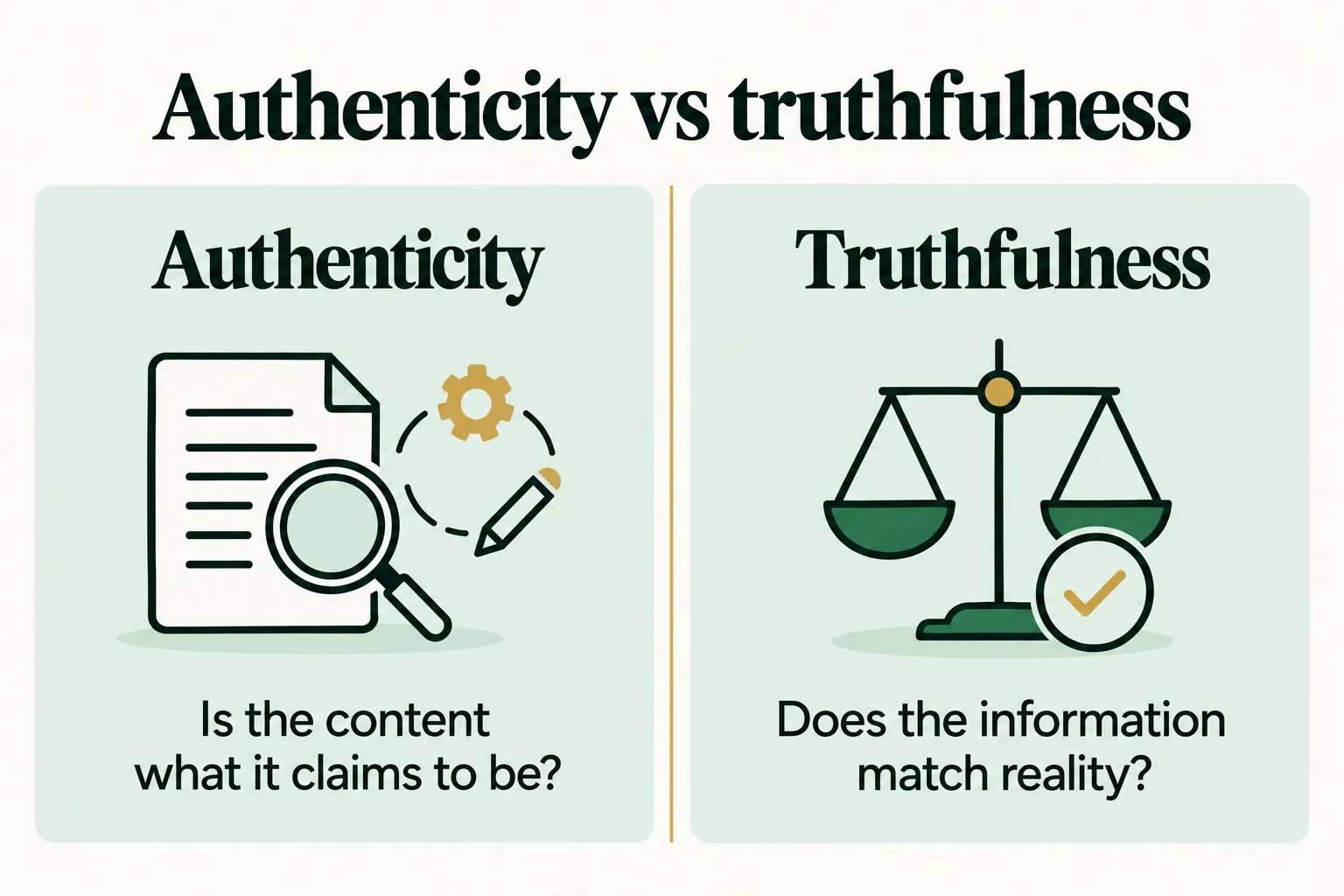
The problem is that part of the explanation is, in my view, tautological:
“Truthfulness pertains to the veracity of the content”.
Replacing the word truthfulness with the word veracity does little to help anyone understand the provision.
I am also troubled by the reference to how an event actually unfolded. Could the historical accuracy of a depiction matter in this reading? Where does artistic fiction end and content that falsely appears truthful begin?
What does this mean for companies?
I would not draw the simple conclusion from these examples that realistic AI-generated backgrounds are always safe as far as the deepfake obligations are concerned.
The more important question seems to me to be what impression the material as a whole creates and what the viewer may conclude from it.
A company preparing an advert should therefore look not only at how an image was made, but also at what it communicates. A synthetic background used purely for aesthetic reasons is a different matter from one that suggests particular features of the product.
I am not a lawyer and I do not treat this interpretation as legal advice. I do believe, however, that a document meant to make the rules easier to understand should explain exactly these borderline cases as precisely as possible.
Yet after reading the guidelines I still have more questions than answers.
Translated from Polish. Read the original