AI made me a thought leader
Gemini made me an almost leading AI guru. Why I usually pick ChatGPT for Deep Research and how to check that a report separates facts from marketing.

I once asked ChatGPT and Gemini to run deep research on myself. Gemini turned me into almost the number one AI guru in Poland. It sounded nice, but it did not match the scale of what I do. I am an AI trainer, I have some visibility online and I have spoken at a few conferences. Not at fifty, and not on television, so I do not have the standing the report gave me.
It is a rather special case. Usually, when I read an analysis of someone else’s company, I do not know all its realities. Here I could immediately check where the model was exaggerating.
Gemini treated my marketing materials almost as independent proof of my position. In other words, it found information about my work online but gave it far too much weight. ChatGPT, in the same kind of research, calmly separated what I say about myself from verifiable facts. For me that was a far more important difference than the presentation.
The same test on someone else’s company
During my latest training session I compared Deep Research reports from ChatGPT and Gemini using one contracting company as an example. Gemini produced a more visually attractive analysis, but ChatGPT convinced me more with the quality of its reasoning. It is not about the number of charts or the length of the report, but about the ability to separate facts from marketing.
ChatGPT prepared a report covering the company’s profile, finances, offer, clients, competition and possible positioning. According to the interface, it ran 216 searches and finished in about four minutes. The report included, among other things, comparisons with five competitors and suggested sales directions.
That does not mean all its conclusions were correct. During the demonstration I already spotted a problem with one footnote. The report linked to a page where I could not find the stated information about the company’s share capital. I also pointed out that strategic recommendations should be treated as hypotheses to be checked by people who know the business, not as ready decisions for the board.
Gemini also produced an analysis of this company. Its graphics and layout were clearer, which I openly admitted to the participants. However, I did not carry out a detailed point-by-point audit of both reports during the session. My preference for ChatGPT comes from combining that demonstration with earlier experience, especially the research on my own business.
Why this matters to a manager
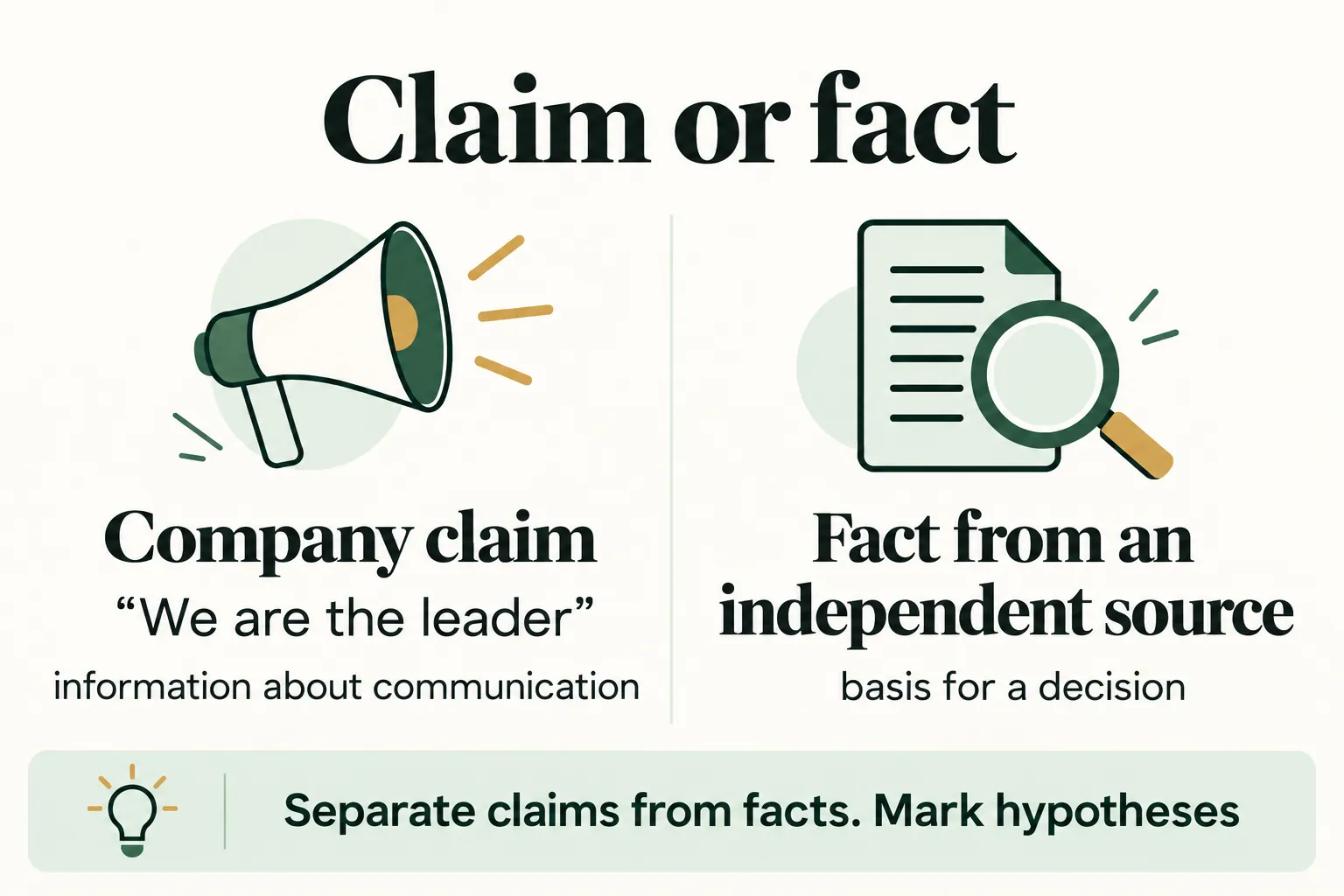
Imagine an analysis of a competitor who writes on its website that it is the market leader. A model may quote that slogan correctly and then make a much more serious mistake: presenting the competitor’s claim as an objective assessment of the market. If you plan a strategy, compare suppliers or assess a business partner on that basis, such a mistake has real consequences.
That is why it is worth stating clearly in a Deep Research request: “Separate companies’ claims from facts confirmed by independent sources. Mark hypotheses and say what could not be verified”. And after receiving the report, open a few sources, especially for the most important data and recommendations.
For now, for this kind of research, I more often choose ChatGPT Deep Research. Gemini can present results better visually, but in my trials ChatGPT was more critical of marketing material. This is an assessment from my own practice, not a universal ranking. Models change, results depend on the topic and on how the task is phrased, and no report should be accepted without checking.
Translated from Polish. Read the original