I don’t want AI to praise me
In my instructions for AI I ask for honesty instead of praise. How to write a prompt so that the model’s criticism helps you make a better decision.

My instructions for AI include a request to work in a “tough love” style (greetings to Franciszek Georgiew of AION MIND). I want directness, honesty and criticism when my idea deserves it. I also ask for technical terms to be explained in plain language.
An assistant that always agrees is not a good partner for assessing decisions.
This is simply how I like to work. When I show these instructions during training, I do not encourage people to copy my whole personality into their own account. I encourage them to work out what they actually expect from the conversation.
If I come with a business idea, praise is not yet help. I need to know what assumptions the plan rests on, what I have not checked and where I am adding work for myself without a clear benefit. I also want to see whether the next step brings me closer to the goal I have set myself.
Custom instructions are only the beginning
You can save such preferences in custom instructions. They let you pass on standing expectations for answers instead of repeating them in every prompt. Saving a preference, however, guarantees neither sound judgement nor consistent application of the instructions.
A sharp tone is not yet good criticism
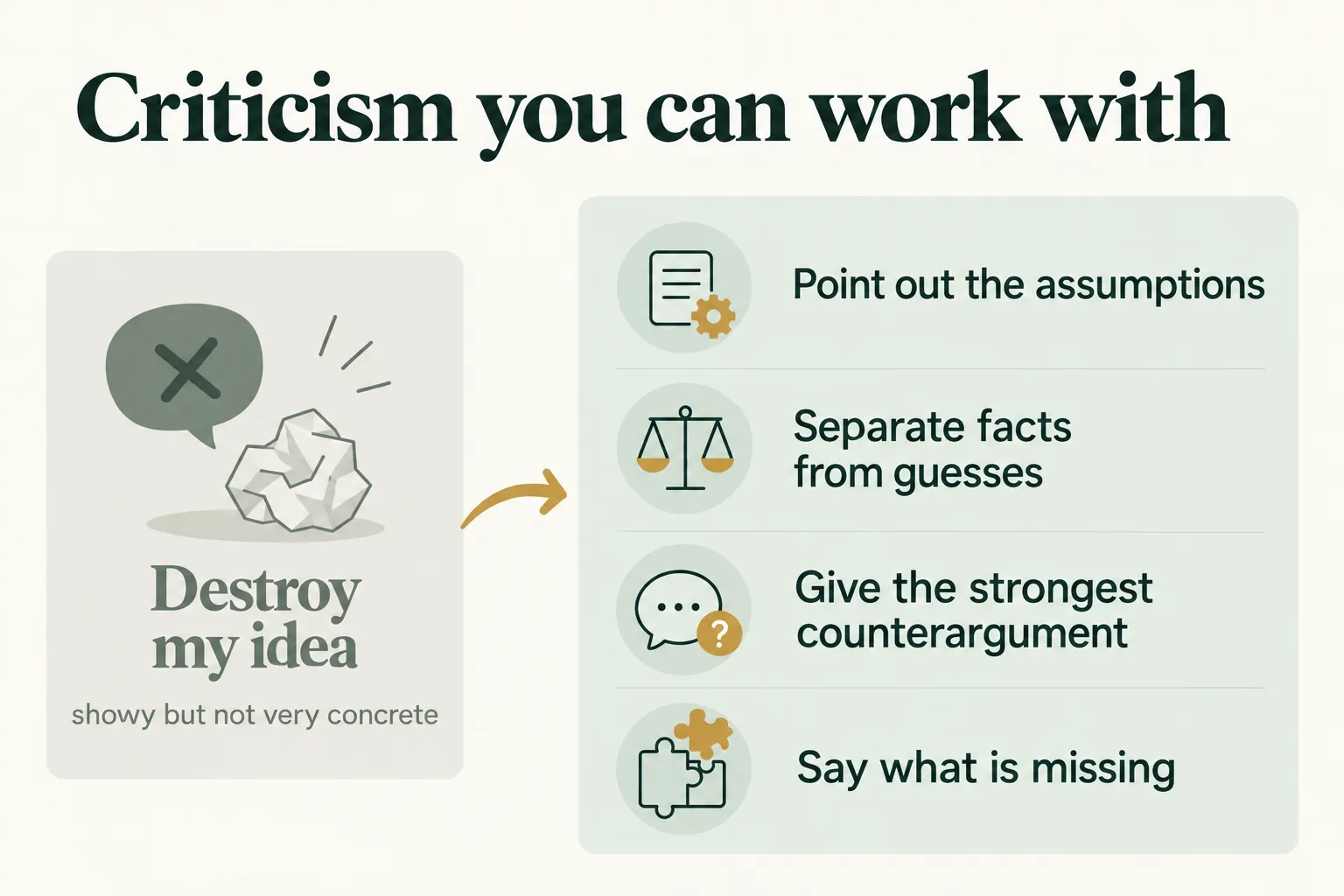
And here is an important trap: a critical tone can also play on our imagination. A firm answer easily sounds like an expert’s voice. If I ask the model to “ruthlessly destroy my idea”, I may get impressive criticism built on weak arguments. The mood of the conversation changes, but the quality of the decision does not necessarily improve.
That is why a better instruction specifies what the criticism should contain. For example: “Point out the key assumptions. Separate facts from guesses. Present the strongest counterargument. Tell me what information is missing for an assessment”. That gives me material to check, not just the feeling that someone is telling me the truth to my face.
It is also worth letting the assistant say that an idea makes sense. Forcing disagreement in every answer would be just as tiring as constant nodding.
My goal is simple: after the conversation I should understand my situation better and know what to do next. If an answer boosts my self-esteem but gives me no useful information, it has not helped me much with the decision.
What this means for a company
Before making a decision, you can ask AI not to support the idea but to give the three strongest counterarguments, the missing data and the conditions under which the recommendation stops making sense. The final judgement still belongs to a person.
Sources: OpenAI, custom instructions.
Translated from Polish. Read the original