I built the website faster than I agreed it with my client
I built a website for a beauty salon with AI faster than my conversations with the client lasted. What is left to do when delivery speeds up.
I built a website for a beauty salon with the help of AI. A paid job, a real client. I also designed the logo, price lists and leaflets.
Speeding up delivery does not remove the work on requirements and acceptance.
When I talked about it during a training session, the proportion struck me: conversations with the client and showing her how to use the website took more time than building the website itself.
How long the build itself took
At the time I estimated that the tool worked on the website for about two and a half to three hours, and my own direct work, not counting the conversations with the client, was perhaps about an hour. This is a rough memory of one project, not a measurement and not a universal price list. I would not conclude from it that any website can be delivered in an hour.
What remains when production speeds up
Much more interesting is what was left to do once the execution part became shorter.
The client still has to decide what she wants to show. Someone has to understand her offer, settle the order of information, assess the design and get it to a version that can actually be used. At the end the result still has to be handed over to a person for whom it is not another technological toy but part of her business.
It is easy to lose this work in a catchy description like “I typed a prompt and the website appeared”. Such a description says something about what can be generated, but little about delivering a service. A design appearing on screen does not tell you whether the offer is clear, whether the contact form works and whether the owner knows what to do when the price list changes.
My lesson from this job is fairly down to earth: as production gets shorter, agreements, assessment and handover make up a bigger share of the work. It is worth starting to measure these stages separately. Otherwise you may promise a client a deadline based on the speed of the tool and ignore everything that depends on people.
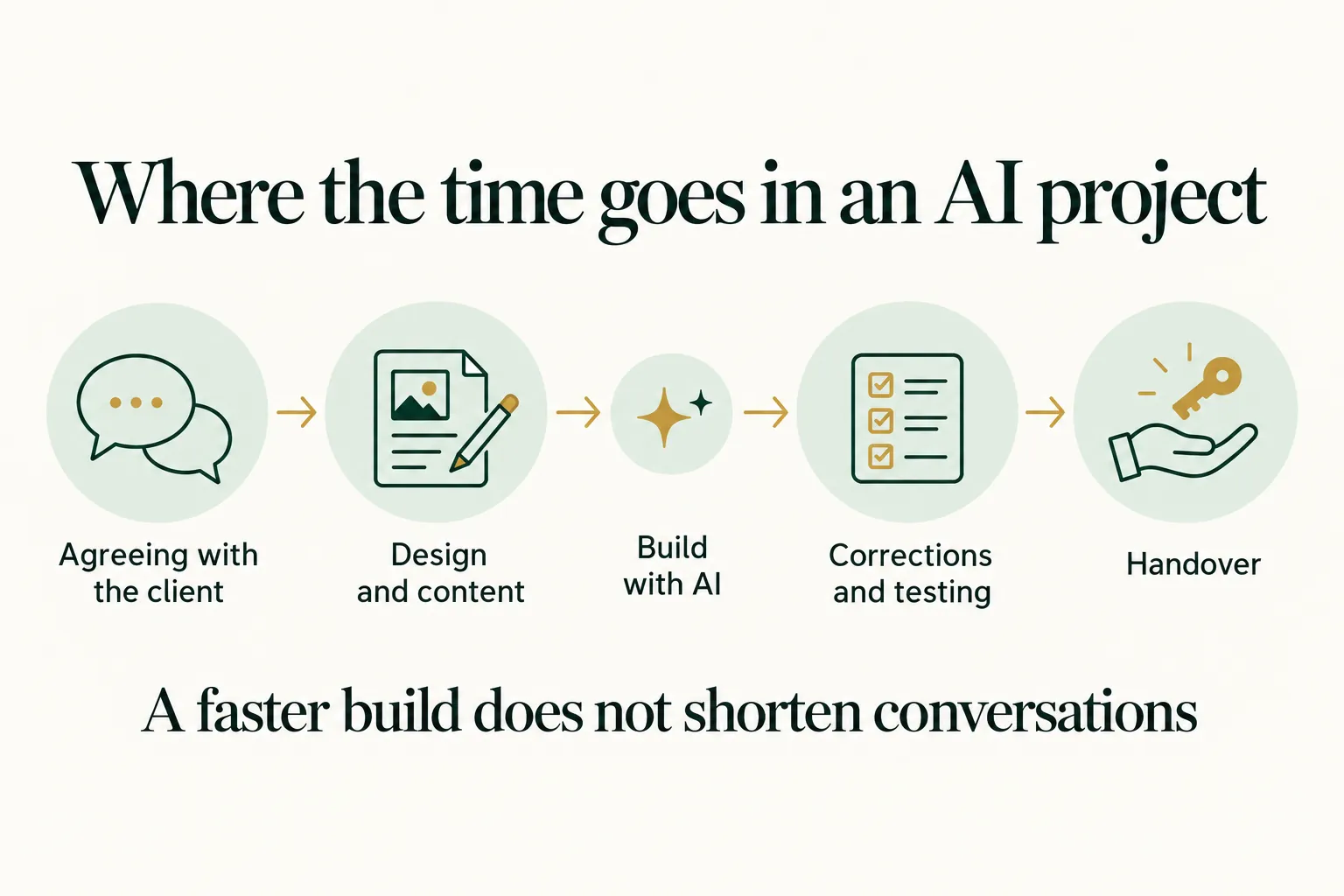
If I were to show this project as an example of using AI, these proportions would be the most important part. The technology allowed me to do more. At the same time it showed very clearly where a service needs conversation and responsibility for the result.
What this means for a company
When planning a project, it is worth estimating separately the time for agreeing requirements, execution, corrections, testing and handover to the client. A shorter production stage does not automatically mean a proportionally shorter project.
Translated from Polish. Read the original