AI in writing grant applications. From finding calls for proposals to reviewing the finished project
How can AI support the grant process? Finding calls for proposals, analysing the documentation, writing applications and assessing the project.
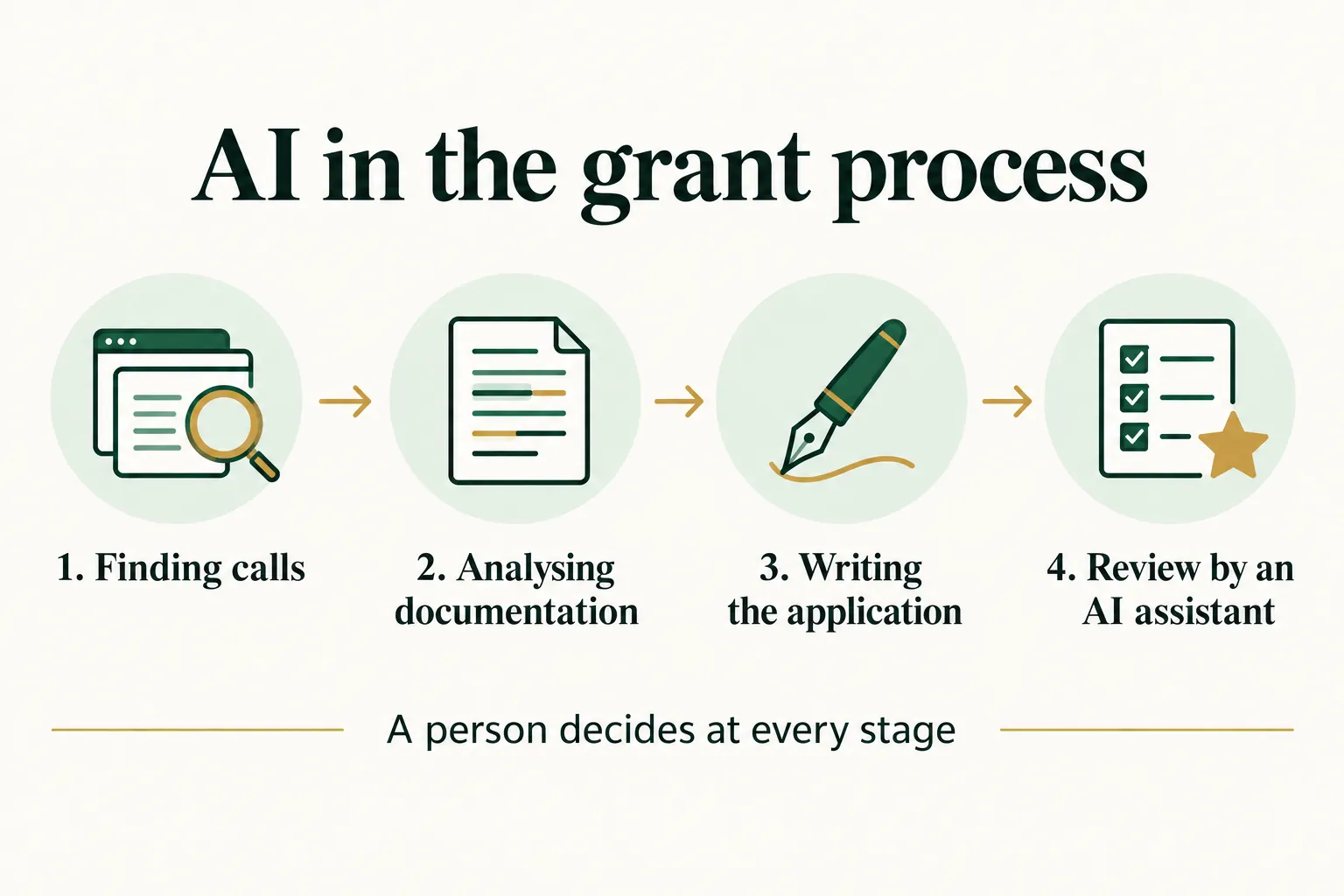
Preparing a grant application is much more than writing a text. You have to find the right call for proposals, analyse the documentation, draft the application and assess its quality. During a training session for the Voivodeship Public Library in Kraków (Wojewódzka Biblioteka Publiczna w Krakowie), I showed how artificial intelligence can support each of these stages.
Finding calls for proposals with AI
One of the first tasks in the grant process is finding funding opportunities that suit the organisation.
This means searching websites and reading up on the calls that are open.
During a full-day training session at the library, I showed how to use AI to search dozens of websites automatically for grant calls.
This use matters because it brings artificial intelligence into the stage before the application is even written.
AI does not have to be limited to producing text. It can also help gather the information you need to start work.
That does not mean finding a call automatically settles whether you can apply for the funding. The information found during the search still has to be checked against the documentation of the call itself.
Analysing the documentation and preparing the application
The next stage is working with the grant documentation.
This is where one of the more important uses of AI comes in. The tool can help analyse the materials for the call and then help prepare the content of the application.
During the training, participants practised both analysing the documentation and writing applications.
I also showed how to use custom AI assistants set up to support specific tasks.
In this approach artificial intelligence is not just a tool for generating text from a single instruction.
It becomes part of the process of working with information.
In the summary of the training, I pointed out that using AI can cut the time needed to write an application by 50-80%.
That figure shows the scale of the possible time savings, but without further data I would not treat it as a guaranteed result.
AI as a critical reviewer of the application
For me, the most interesting part of the training was not the writing itself but checking the finished documents.
Participants built AI assistants whose job was to critically assess existing grant applications.
We were also able to compare the scores given by the assistants with the real scores awarded by the evaluation panel.
In every case we analysed, the assistants’ scores were within the margin of statistical error of the panel’s actual score.
It is an interesting result, but it needs to be read with caution.
Without more information, you cannot conclude that AI will assess any grant application equally well.
I do, however, think the idea of using AI as an additional reviewer is a valuable one.
The whole process matters more than a single prompt
Grant applications are a good example of complex work with information.
A single process involves searching for data, analysing documents, writing text and critically assessing the result.
Each of these stages can be treated as a separate task for AI. But I see the greatest potential in combining them into one coherent way of working.
The training at the Voivodeship Public Library in Kraków showed me that even people starting from the basics can put AI tools to practical use in the grant process.
I would not reduce this use to writing applications automatically.
What matters more to me is that artificial intelligence can support the work at every stage, from looking for information to assessing the finished document.
Translated from Polish. Read the original