NotebookLM at work. How to turn documents and recordings into a useful knowledge base
How can a company use NotebookLM for knowledge management? Practical uses, document analysis and answers that point to their sources.
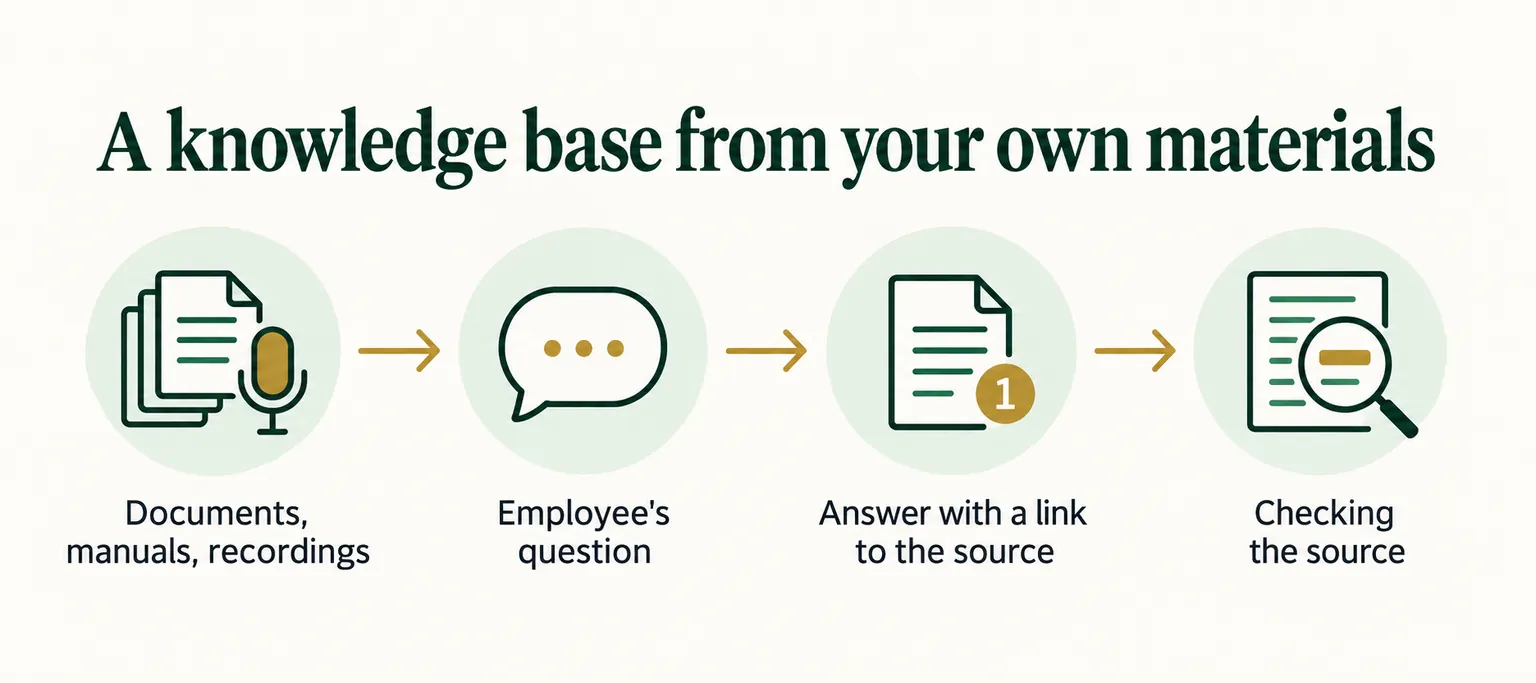
Companies collect documents, manuals, presentations and recordings, but having these materials does not mean employees can make good use of the knowledge they contain. The problem is often not a lack of information but the difficulty of finding it. NotebookLM is a tool that can help turn such a collection into a knowledge base you can hold a conversation with.
More than a hundred hours of knowledge available at work
“Franek, don’t you have a model that won’t make things up?” I hear this question very often. Usually, after a few sentences of explanation, someone says something like: “I tried uploading these files to Gemini and ChatGPT, but they talked nonsense.” That is when I answer: put them into NotebookLM.
One of my acquaintances analyses DNA test results. NotebookLM has become his favourite tool. He uploaded 115 hours of lectures by a DNA expert that he had been collecting for years. Now he has more than a hundred hours of specialist knowledge at hand and can refer to it while he works.
This example shows me the value of NotebookLM very well.
The point is not for artificial intelligence to replace the expert. The point is to be able to quickly find and use knowledge that someone has already worked out.
How can a company use NotebookLM?
The same principle can be applied to company materials.
I can imagine an organisation that has spent years gathering information about its procedures, solutions and ways of getting things done. Some of this knowledge is in documents, some in training materials and some in recordings of specialists talking.
NotebookLM lets you treat such materials as a basis for asking questions and finding the information you need.
One use is managing company knowledge. Instead of going through many documents every time, an employee can look for answers by referring to the collected materials.
The second is onboarding new employees. A well organised knowledge base can make it easier to learn how the organisation works, which solutions it uses and what its internal procedures are.
The third is building a knowledge base of the legal solutions the company uses. This does not, of course, replace a lawyer’s judgement, but it does make it easier to use materials that have already been prepared.
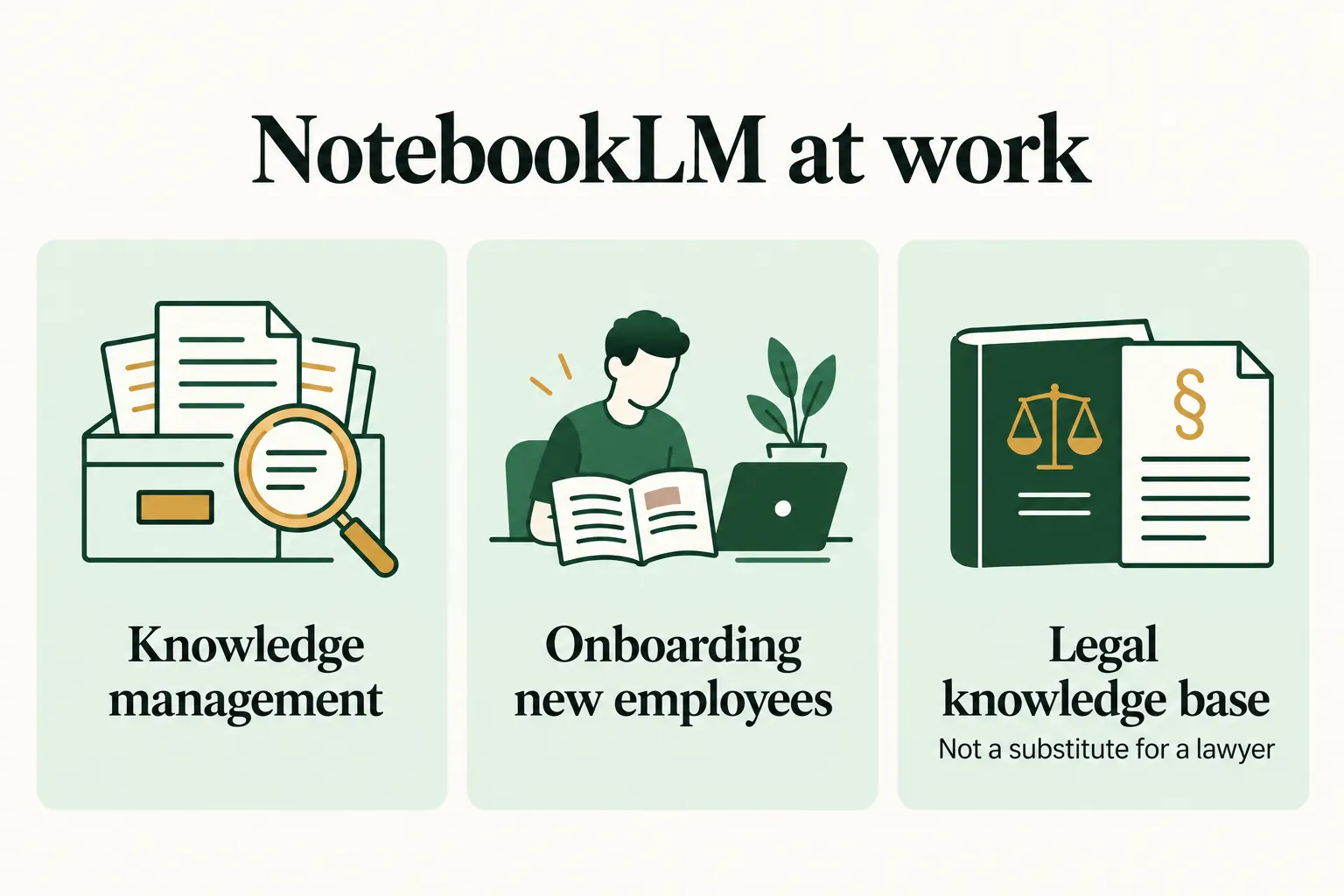
In each of these cases the starting point is the documents and knowledge the organisation already has.
An AI answer is not enough. You need the source
For me, the most important feature of NotebookLM is that you can go from the generated answer straight to the source material.
Answers come with references that let you check where a given piece of information comes from.
That is a fundamental difference in the way you work.
An ordinary chatbot answer forces you to work out whether its claims are correct. In NotebookLM I can go straight to specific passages in the materials I provided.
This does not make the tool infallible. It can still misinterpret a source, and pointing to a passage in a document is not proof that every conclusion is correct.
Checking the answers, however, becomes much easier.
This matters especially when an employee needs not only quick information but also a way to establish where it came from.
From an archive to knowledge you actually use
NotebookLM can be useful outside companies too.
I would mention preparing for exams, support when writing a university thesis and analysing large collections of podcasts and specialist materials.
The same problem comes up in all of these uses: there is a lot of material, and the time available for finding the right passage is limited.
My acquaintance’s example shows that even highly specialised knowledge can become easier to access if it is made available to the tool in the right way.
That is why, from a company’s point of view, I would not start by asking how much new content AI can generate.
I would start with a different question: how much valuable knowledge does the company already have but cannot use efficiently?
Translated from Polish. Read the original